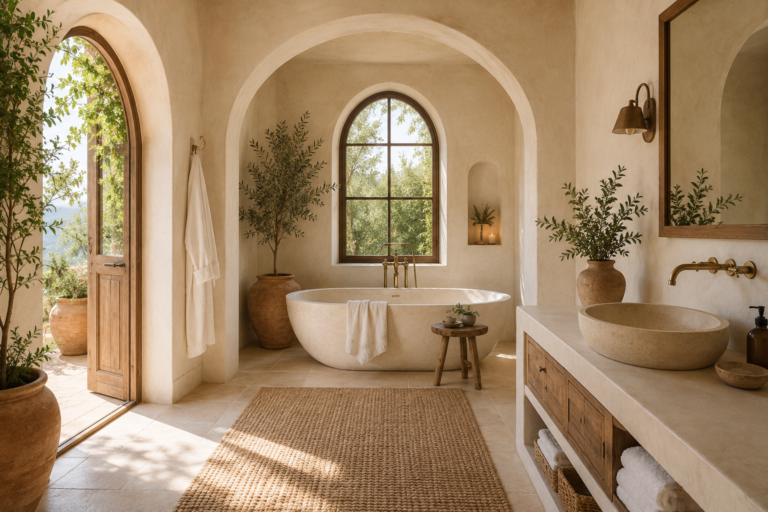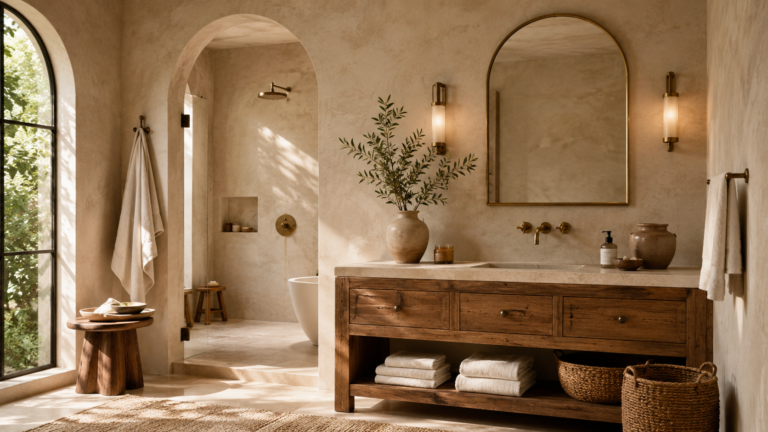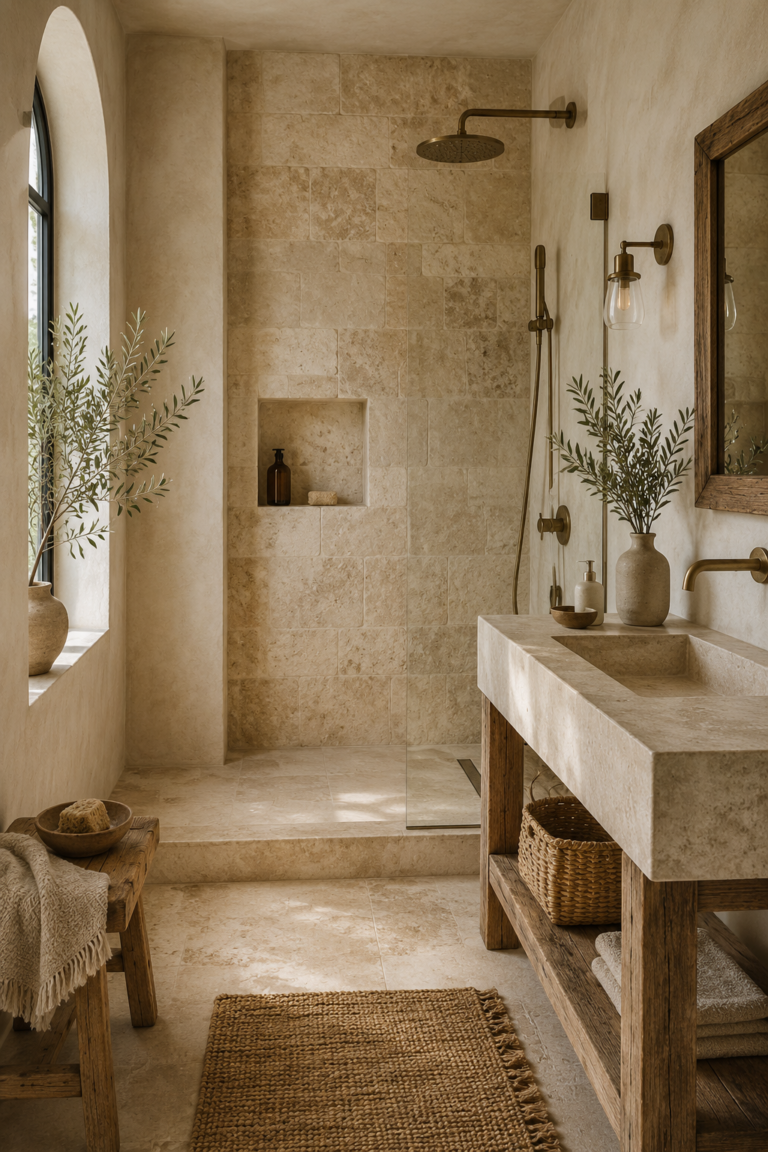
Mediterranean Bathroom Ideas for a Windowless Bathroom That Still Feels Warm and Fresh
A windowless bathroom can make even beautiful materials look flat. Cream tile turns gray, brass reads dull, and every towel seems to hold more visual weight than it should. The usual answer is to add a bright white shower curtain, a glossy mirror, and stronger overhead light, but that often makes the room feel more clinical rather than more alive.
For a Mediterranean bathroom, especially one inspired by the quiet homes of Provence, the better approach is gentler: warm the surfaces, soften the light, reduce visual noise, and choose objects that look as if they belong in a modest stone house rather than a themed spa. The goal is not to fake sunlight. It is to create a bathroom that feels dry, calm, tactile, and fresh even when there is no window at all.
The real problem is not darkness, but flatness
In a bathroom with no natural light, the eye has less information to work with. A shaded corner, a plaster texture, or the subtle variation in a handmade tile would normally come alive during the day. Without that changing light, everything becomes more even and more unforgiving.
This is why many windowless bathrooms feel strangely cold even when the palette is beige. The color may be warm in theory, but the finish, lighting, and layout are not doing enough. A glossy floor reflects the ceiling fixture in a hard way. A cool bulb makes the sink area feel blue. A cluttered vanity casts tiny shadows everywhere. The room may be clean, but it does not feel settled.
A Provençal reading of Mediterranean style solves this by leaning into low contrast and honest texture. Think chalky plaster, matte stone, unbleached linen, a small ceramic dish, a worn wooden stool, and blackened or aged brass hardware. These elements do not need bright sun to make sense. They bring their own depth because their surfaces are varied rather than shiny.
Choose a base color that looks warm under artificial light
Pure white is rarely the most flattering wall color in a windowless bathroom. It can look crisp in a sunlit mas near Aix, but under a single ceiling fixture it often becomes stark and slightly gray. A soft chalk, warm ivory, pale sand, or very muted limestone tone is usually easier to live with.
If you are painting existing walls, test samples beside the mirror, behind the door, and near the shower. In a room with no window, the bulb is effectively the sun, so the color must be judged under the actual light you will use every day. Avoid anything too yellow, which can make white sanitaryware look mismatched, and anything too taupe, which can feel muddy when the room is closed up.
For a more textured finish, limewash-style paint can be beautiful, but it must be chosen carefully in a bathroom. Use it where splashing is limited, such as above tile wainscoting or on the upper wall away from the shower. In wet zones, a practical bathroom-rated finish or tile is the safer choice. The Mediterranean feeling should come from the tone and texture, not from using a delicate material in the wrong place.
Keep the wet zone quiet and matte
The shower or tub surround takes up a large amount of visual space, so it sets the mood. In a windowless bathroom, a busy patterned tile can quickly become oppressive because there is no daylight to soften it. A quieter surface is usually better: handmade-look ceramic in warm white, matte porcelain with a limestone character, pale travertine tones, or a simple shower curtain in natural linen color.
If the existing tile is plain but serviceable, do not rush to replace it. The correction may be as simple as changing the curtain, grout tone, lighting, and accessories around it. A white plastic liner visible from across the room can undo an otherwise warm scheme; a linen-look curtain or an outer fabric panel in oatmeal, stone, or chalk softens the entire wall.
For enclosed showers, clear glass can be useful in a small room because it allows the eye to continue to the back wall. But if the shower fittings, bottles, and grout are visually busy, clear glass also exposes everything. In that case, restraint matters: decant only if it truly simplifies the shelf, keep daily products in one niche or basket, and avoid turning the shower wall into a display area.
Use lighting in layers, not one intense ceiling fixture
A Mediterranean bathroom should feel warm, but not dim. This is the important distinction. In Provence, shadow is part of the beauty: a lantern against plaster, a wall light near a mirror, a soft glow on stone. In a windowless bathroom, however, shadow must be controlled so the room remains functional for shaving, makeup, cleaning, and laundry.
The most reliable plan is to combine a general overhead source with lighting at face level. If you only have a ceiling fixture, consider adding a wall light near the mirror where wiring allows, or use a mirror with integrated lighting if that suits the room. A single fixture above the mirror can cast shadows under the eyes; paired side lighting is often more flattering, especially in narrow bathrooms.
Choose warm, diffused light rather than exposed harsh light. Frosted glass, linen-like shades placed safely away from splashing, or opaque sconces can help. Very decorative lantern-style fixtures may look charming in photos but can create striped shadows on the face. Save that effect for a hallway or terrace; in a bathroom, practical softness is more important.
A five-decision framework for the room
Before buying anything, make five decisions in this order. It keeps the room from becoming a collection of Mediterranean-looking pieces that do not actually solve the windowless condition.
- First, decide the wall temperature: chalk, warm ivory, pale sand, or limestone. This becomes the quiet background for everything else.
- Second, choose one main texture: matte tile, plaster-look paint, travertine, or natural linen. Repeating one texture feels calmer than adding many small decorative ideas.
- Third, fix the mirror zone: use a mirror shape and light placement that make the vanity feel intentional, not leftover.
- Fourth, limit the metal finish: aged brass, blackened iron, or simple brushed metal. Mixing too many metals can make a small bathroom look restless.
- Fifth, add only useful objects: towels, hooks, baskets, soap dish, tray, and perhaps one small vase. If it does not serve the room, leave it out.
Rework the vanity so it feels built-in, not busy
The sink area is where windowless bathrooms often become visually crowded. Toothbrushes, skincare, soap, towels, outlets, and mirror edges all compete in a very small space. Mediterranean style does not fix this with more decoration; it fixes it with better containment and warmer materials.
If your vanity is modern and flat, warm it with a few restrained choices. A travertine or wood tray can gather the daily items. A handmade ceramic soap dish adds irregularity without adding pattern. Linen towels in a natural shade bring softness to the hard sink edge. The goal is to create one composed area rather than many little objects scattered across the counter.
For cabinetry, matte finishes are usually more convincing than glossy ones. Painted wood in warm off-white, mushroom, muted olive, or pale greige can sit beautifully with brass or blackened hardware. If you rent and cannot paint, focus on what can change: the mirror, towel hooks, shade of the towels, counter tray, and storage baskets.
Mirror shape matters more than ornament
An arched mirror can be useful in a Mediterranean bathroom, but only if it feels proportional. It should not be so ornate that it turns the room theatrical. A simple arch with a slim frame can soften square tile, a rectangular vanity, and a standard tub. In a low ceiling bathroom, a vertical mirror also helps draw the eye upward.
If the sink is very narrow, a rounded rectangle may be better than a full arch. The principle is softness, not a mandatory shape. Avoid frames that are too shiny or too thick for the room. A windowless bathroom benefits from reflection, but it does not need a mirror that dominates every wall.
Storage should look breathable, but still handle moisture
Baskets are a natural fit for Mediterranean bathrooms, especially when they echo cane chairs, market baskets, and woven details found in Southern French homes. But bathrooms are damp, so placement matters. Use woven baskets outside the splash zone, preferably on an open shelf, under a vanity with airflow, or beside the door for rolled towels.
Closed storage remains important. A bathroom that displays every bottle will never feel calm, no matter how beautiful the tile is. Keep daily products inside a cabinet where possible, then allow a few practical objects to remain visible. One soap dish, one towel, one tray, and one basket can do more for the room than a shelf full of decorative jars.
Linen is another material that brings the right softness, but it should be used realistically. Linen towels and curtains crease; that is part of their charm. If you prefer a perfectly smooth hotel look, choose another fabric. In a Provençal setting, a slight rumple is not a flaw. It keeps the bathroom from feeling overdesigned.
Add Mediterranean character without making the room heavy
A windowless bathroom cannot carry the same amount of visual weight as a sun-filled space. Deep terracotta walls, dark patterned floor tile, heavily carved mirrors, and multiple black iron accents may look romantic in a large bathroom with a window, but they can close in a compact interior room.
Use darker or earthier notes in small doses. A terracotta vase on a shelf, aged brass hooks, a small olive-toned hand towel, or a black metal detail can be enough. The base should remain pale and mineral. This gives the room the feeling of thick walls and cool stone without making it somber.
If you want pattern, keep it close to the floor or in one small textile. A vintage-style rug can work if the bathroom has enough ventilation and the rug can be washed or aired. In a tight bath used by several people, a simple, quick-drying mat may be wiser. Mediterranean style should support daily life, not complicate it.
Ventilation and cleaning shape the final design
Beautiful bathrooms fail when maintenance is ignored. In a room without a window, ventilation is not optional. Make sure the fan is used consistently and that towels have space to dry. Hooks are convenient, but a towel folded thickly on a small hook may stay damp longer than one spread on a bar. If hooks are your only option, use fewer towels and allow space between them.
Matte surfaces also need thoughtful care. They hide glare but can show soap residue if cleaning is neglected. Choose simple accessories that can be lifted easily when wiping the counter. Avoid too many small ceramics around the basin, where splashing is constant. A bathroom that is easy to clean will stay fresher and more serene over time.
For scent, be restrained. A small bar of well-made soap, fresh eucalyptus used sparingly, or a clean linen spray outside the wet zone is enough. Heavy fragrance can make a windowless room feel enclosed. Freshness should come first from airflow, dry towels, and clean surfaces.
Shop the Look
These pieces suit a warm, restrained bathroom scheme where texture, practical storage, and soft finishes matter more than overt decoration.
- brass towel hooks
- handmade ceramic soap dish
- linen towels
- woven storage baskets
- arched bathroom mirror
- linen shower curtain
A room that feels cared for, not decorated
The best windowless Mediterranean bathroom is not packed with references. It does not need patterned tile on every surface or a shelf of imported-looking objects. It needs warmth where the light is flat, softness where the fixtures are hard, and enough restraint for the room to breathe.
Start with the surfaces that affect the whole space: wall color, shower area, mirror, and lighting. Then add the tactile pieces slowly. Linen, ceramic, woven storage, brass, and a little terracotta can give the bathroom a Provençal quietness without turning it into a set. When the room is easy to clean, gentle to use, and calm at night, it has achieved the more lasting version of Mediterranean style.
Affiliate disclosure: La Maison du Sud may earn a commission from qualifying purchases made through links in this article, at no extra cost to you.