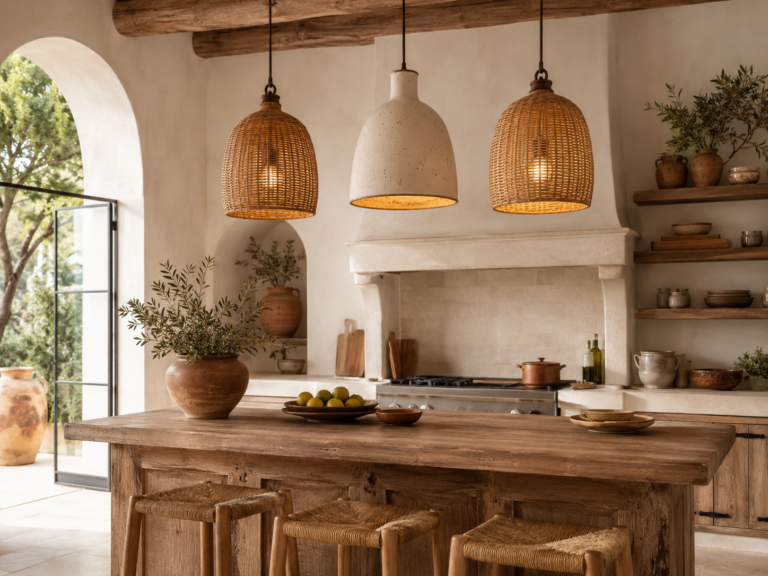
Mediterranean Entryway Ideas for a Narrow Foyer That Feels Warm, Not Cluttered
A narrow entryway has a way of exposing every design decision. A console that looked graceful online suddenly blocks the door swing. A basket meant for shoes becomes a permanent obstacle. A mirror reflects the hallway ceiling instead of the light. The challenge is not making the space look Mediterranean in a decorative sense; it is making a tight passage feel calm, sun-warmed, and useful the moment you step inside.
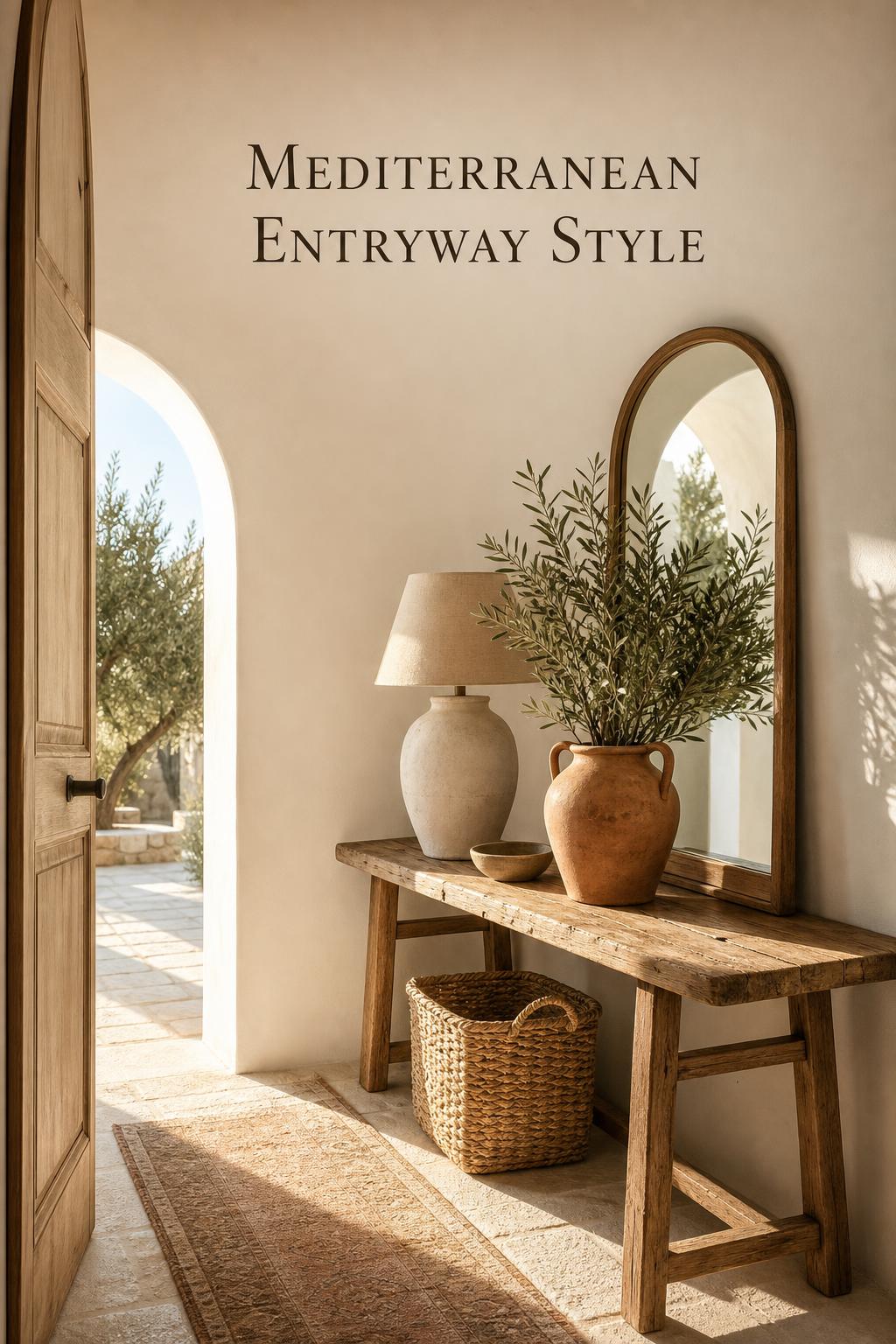
For this kind of foyer, the best Mediterranean cues are the quiet ones: limewashed tones, aged wood, clay, woven fibers, soft brass, a sculptural mirror, and one good glow at eye level. The room may be small, but it still deserves depth. The key is choosing pieces that hug the wall, earn their footprint, and create the feeling of a collected Southern home without turning the entry into a display shelf.
Start with the bottleneck, not the style
Before thinking about arches, pottery, or terracotta, stand at the narrowest point of the entry and watch how the space is used. Where do people pause? Which direction does the front door swing? Is there a closet door, staircase, radiator, return vent, or awkward corner that interrupts the wall? Mediterranean entryways often look effortless because the practical elements are absorbed into the architecture. In a narrow foyer, you have to create that same ease with furniture placement.
If the hallway is used as a true pass-through, avoid deep furniture. A standard dresser-depth console can make the foyer feel pinched even if it technically fits. Look for a slim console, wall-mounted shelf, or narrow demilune table that gives you a landing place for keys without demanding the center of the room. If the entry opens directly into a living room, use one vertical element, such as an arched mirror or tall lamp, to signal arrival without building a visual wall.
The most successful narrow Mediterranean foyer usually has only three functional zones:
- A landing surface for keys, mail, sunglasses, or a small tray.
- A vertical focal point such as a mirror, framed textile, wall sconce, or tall branch arrangement.
- A contained storage moment for shoes, scarves, dog leashes, or everyday bags.
Anything beyond those three should be questioned. The foyer is not the place to solve every household storage issue. It is the threshold, and thresholds need breathing room.
The narrow-foyer measurement rule
Use one simple measurement rule before buying anything for a tight entry: keep at least 36 inches of clear walking path wherever possible, and do not let furniture project more than one-third of the hallway width. If your entry is only 42 inches wide, a 16-inch-deep console will feel large even if it fits on paper. A 10- to 12-inch ledge, shallow cabinet, or wall shelf will usually look more tailored.
This rule also helps with mirrors and lamps. A mirror that is very wide can make a narrow foyer feel like a corridor of reflections, while a tall, slightly narrower mirror draws the eye upward. A table lamp should sit fully on the surface with shade clearance, not hover near elbows and coat sleeves. If you are using a lamp on a very shallow console, choose a smaller base and place it toward the wall, leaving the front edge open.
Rugs need the same discipline. In a narrow foyer, leave a modest reveal of floor on both sides so the runner looks intentional rather than forced. If the flooring is stone, terracotta, wood, or even a simple matte tile, that border becomes part of the composition. A runner that covers everything can make the space feel more like a hallway in a rental building than the entrance to a layered home.
Choose a base that looks built-in without carpentry
The foundation piece determines whether the entry feels graceful or improvised. In Mediterranean interiors, heavy furniture can be beautiful, but narrow entries often need lighter profiles: an aged wood console with slim legs, a shallow cabinet with simple paneling, a wall-mounted shelf, or a bench that sits close to the wall.
Wood is usually the safest material because it softens the harder finishes commonly associated with Mediterranean style. If the walls are white, cream, or plaster-toned, a medium or dark wood base gives the entry some gravity. If the foyer already has wood floors, choose a wood that is close in warmth but not an exact match. A slight contrast feels collected; a near-match that is just a little off can look accidental.
For very tight entries, consider a bench instead of a table. A narrow bench gives you a place to put on shoes and can still hold a small basket underneath. Look for simple construction rather than ornate carving. Mediterranean style can handle rusticity, but in a confined entry, too much scrollwork or distressing becomes visually noisy.
If you rent or do not want to commit to built-ins, avoid pieces that require anchoring unless there is a safety concern. A freestanding console paired with a mirror and basket can look complete without cabinetry. The trick is to align the widths: the mirror should relate to the table below it, and the basket should tuck fully beneath or sit clearly to one side. Floating, unrelated pieces are what make small foyers feel cluttered.
Bring in Mediterranean texture without stealing walkway space
Texture is where a narrow foyer can feel rich without becoming crowded. Because you may not have room for large furniture, let the surface materials carry the character. Clay, rattan, linen, carved wood, unlacquered brass, and ceramic all bring the sunbaked atmosphere associated with Mediterranean homes.
Instead of adding many decorative objects, choose fewer pieces with stronger material presence. A single ceramic vase with olive branches is more effective than a lineup of small accessories. A woven basket with a tight silhouette is better than a floppy one that collapses into the walkway. A linen-covered shade on a lamp gives the space softness without adding another pattern.
Good textures for a narrow Mediterranean entry
- Ceramic and terracotta for a grounded, handmade feeling on a console or shelf.
- Woven seagrass or rattan for umbrella stands, baskets, or a small covered storage piece.
- Aged wood for a console, bench, tray, or mirror frame.
- Matte brass or blackened metal for hooks, lamp bases, or subtle hardware.
- Linen and cotton for a soft lampshade, small cushion, or curtain near a glazed door.
Be careful with too many woven elements in one small entry. A rattan lamp, woven basket, woven mirror, and jute runner can quickly blur together. Mediterranean interiors work best when rough and smooth surfaces balance each other. Pair a woven basket with a ceramic lamp, or a wood console with a plaster-toned wall and brass hook. The variation keeps the look warm rather than thematic.
Lighting that flatters plaster, stone, and evening arrivals
Entry lighting is often too harsh. A ceiling fixture alone can flatten a small foyer and cast shadows under the eyes, especially if the walls are white. Mediterranean homes tend to feel inviting because the light is layered and warm. Even in a narrow entry, you can create that effect with one secondary light source.
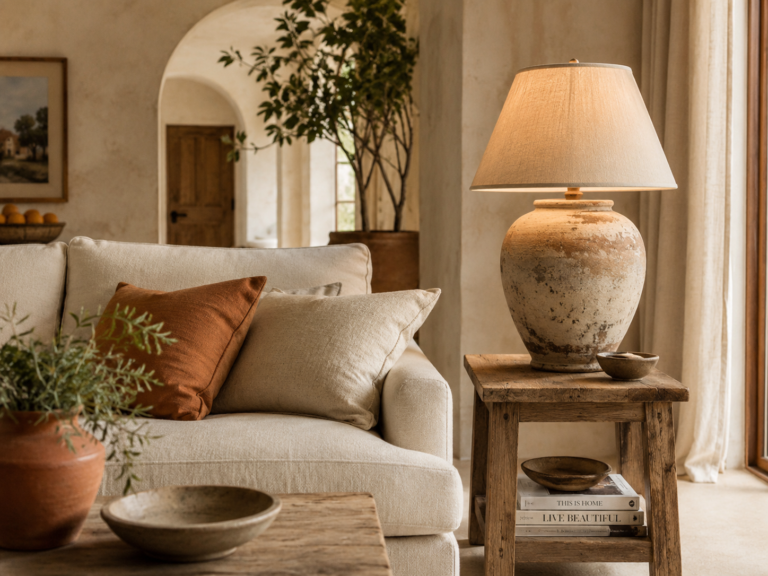
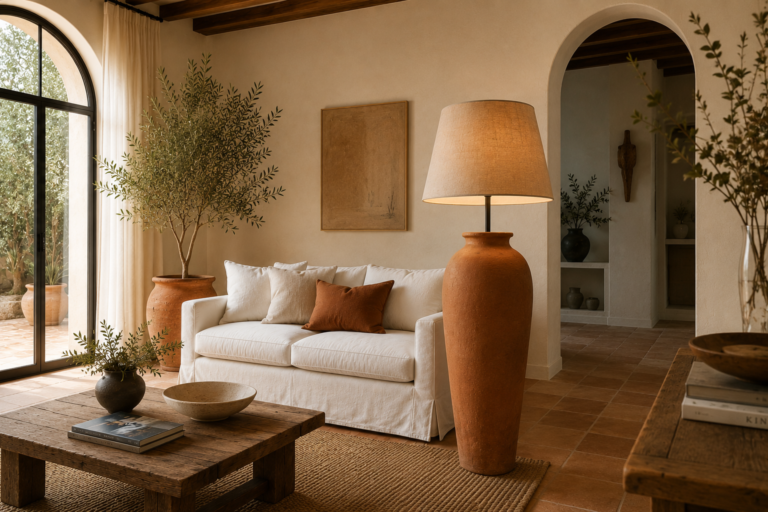
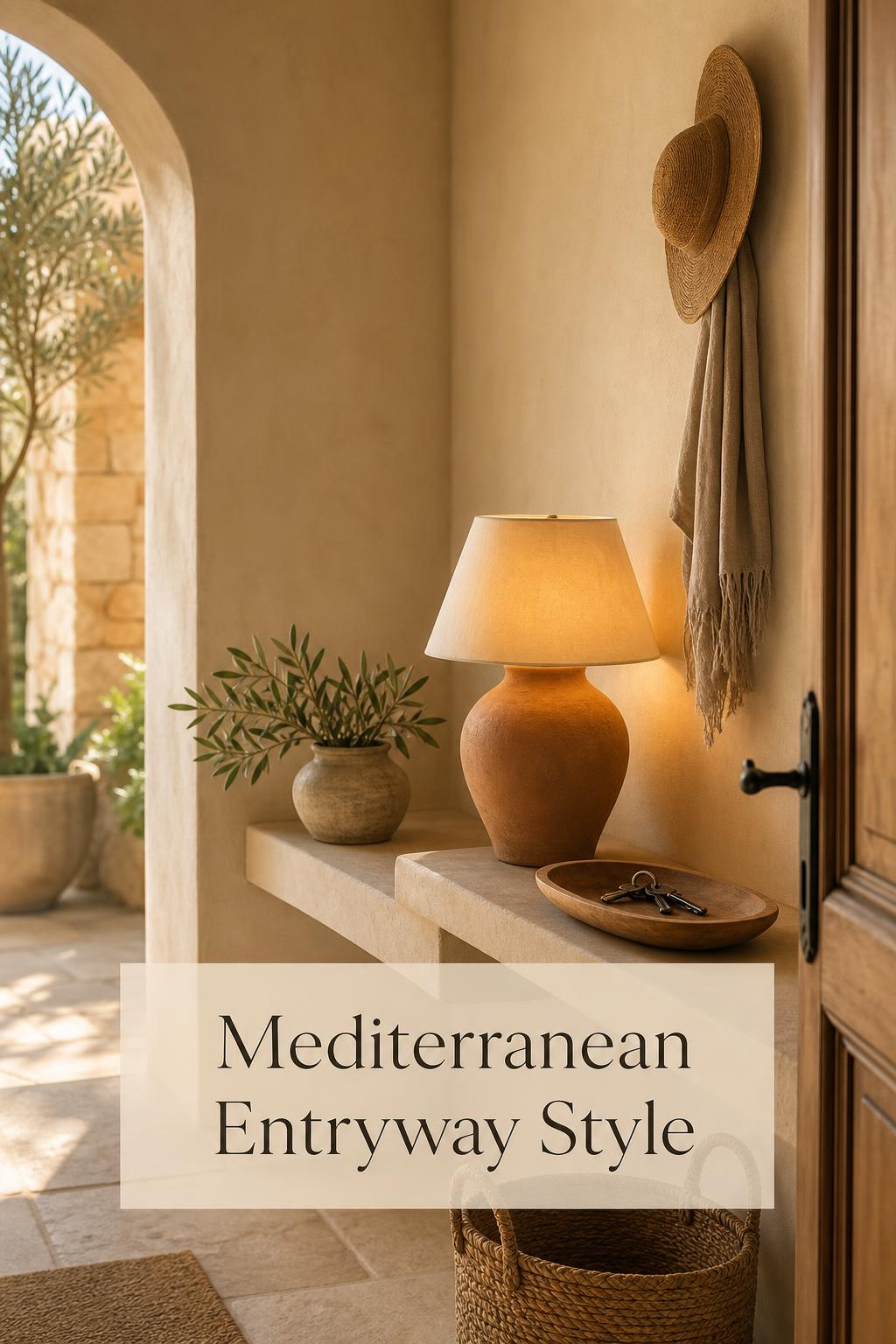
A table lamp on a slim console is the easiest solution if there is an outlet nearby. Choose a shade that diffuses light rather than exposing the bulb. Linen, paper, or woven shades are especially forgiving in small spaces because they spread a gentle glow across walls and wood. Ceramic and terracotta lamp bases feel particularly at home in this setting, especially when paired with a simple mirror or natural branch arrangement.
If there is no console, try a wall sconce, plug-in sconce, or low-profile picture light over a mirror. The placement matters. Lighting mounted too high can feel like a commercial corridor; lighting at approximately eye level creates a more intimate welcome. If the entry has a tall ceiling, use vertical elements beneath the light, such as a mirror or framed art, so the fixture does not float alone.
Bulb color is worth attention. Very cool bulbs can make cream walls look gray and terracotta look dull. Look for a warm light temperature rather than daylight-bright output, especially if the foyer opens into rooms with linen, wood, stone, or warm white paint. The goal is not maximum brightness. It is a soft transition from outside to inside.
Storage that feels decorative, not like a drop zone
Every entryway needs storage, but a narrow Mediterranean foyer should hide the evidence of daily life as much as possible. Open hooks packed with coats can destroy the calm of the entire space. If hooks are necessary, limit them to the side wall or a less visible stretch near the door rather than the central focal wall.
Baskets are useful, but scale is everything. One long, low basket under a bench often looks cleaner than three small baskets lined up like bins. If shoes are the problem, choose a lidded basket or a shallow cabinet so the entry does not become a visible shoe rack. For dog leashes, umbrellas, or rolled scarves, a tall basket can work if it sits in a corner where it will not be kicked or bumped.
A tray on the console is one of the most effective small-entry tools. It turns loose objects into a deliberate still life. Choose wood, stone, ceramic, or woven material rather than shiny acrylic or mirrored finishes. A tray should be large enough to hold keys and mail, but not so large that it consumes the whole surface. Leave at least a third of the tabletop empty; that negative space is what makes the foyer feel composed.
If the front door opens directly into the living room, create a small entry function along the nearest wall instead of pretending the foyer exists. A narrow wall shelf, mirror, lamp, and basket can define the threshold. Use the same color palette as the living area so the entry reads as part of the room rather than a separate mini vignette.
Color, art, and scent in a transitional space
A narrow foyer is not always the place for a dramatic color experiment. Strong color can be beautiful, but in a compressed passage it changes quickly with shadows and artificial light. Mediterranean palettes tend to be most convincing here when they are mineral rather than sugary: warm white, chalk, sand, clay, olive, tobacco, faded ochre, soft black, and muted blue-gray.
If the walls are plain drywall, a limewash-style paint finish or warm matte paint can give the space depth without pattern. In a rental, you can get a similar feeling with art, textiles, and lampshades rather than changing the walls. Avoid bright white bulbs and glossy white furniture, which can make the entry feel stark instead of sun-washed.
Art should be chosen for proportion before subject. A small print floating above a console often looks timid. One taller piece, an arched mirror, or a pair of vertically stacked frames usually suits a narrow wall better. Mediterranean entryways do not need obvious coastal imagery. A charcoal sketch, antique-style landscape, architectural study, framed textile, or simple plaster relief can feel more timeless.
Scent is another subtle layer, but it should be restrained. A bowl of dried bay leaves, a small bundle of lavender, or a candle kept unlit on a tray can add atmosphere without overwhelming guests at the door. Avoid making the foyer smell like a perfume counter. The best entry scent is barely there, like air moving through herbs and clean linen.
How to adjust the look for real-life constraints
The most beautiful entry is the one that still works on a rainy Tuesday. If children use the foyer, choose wipeable baskets, a darker runner, and hooks they can reach. If pets pass through, avoid fragile pottery at tail height and keep the floor clear. If the entry gets strong sun, rotate natural fibers and avoid placing delicate art where it may fade.
Flooring matters, too. Terracotta and stone are naturally compatible with Mediterranean design, but they can be cold underfoot or uneven for some households. A runner softens the acoustics and adds grip, but make sure it has a secure rug pad and does not interfere with the door. On wood floors, a faded wool or cotton runner gives a softer French-Mediterranean note. On tile, woven or flatweave textures can look beautiful, but they must be easy to shake out or vacuum.
Budget should go toward the pieces you touch and see every day: the landing surface, lighting, and storage. Decorative extras can be modest. A beautiful lamp on a simple table will do more for the foyer than a collection of small objects on a poor-quality console. Likewise, one well-scaled mirror can make the whole entry feel finished even if the rest of the arrangement is spare.
If you are starting from nothing, begin with the wall piece and the light. Those two decisions set the mood. Then add storage only where daily life proves you need it. This prevents the entry from becoming overfurnished in anticipation of problems that may not actually exist.
Shop the Look
For a narrow Mediterranean foyer, focus on pieces that add warmth and function without crowding the walkway: a softly shaped mirror, one textured light source, contained storage, and a small surface detail for everyday objects.
- arched mirror for a narrow entry wall
- ceramic table lamp for a warm console glow
- terracotta table lamp with Mediterranean texture
- woven storage baskets for shoes and small entry clutter
- wooden tray for keys and mail
- simple ceramic vase for branches or greenery
Let the entry feel gathered, not decorated
A Mediterranean entryway does not have to announce itself loudly. In a narrow foyer, the quieter choices are often the ones that feel most authentic: a warm wall color, a slim wood surface, an arched reflection, a lamp that softens the evening, and storage that keeps the passage clear. When the proportions are right, even a small entry can feel generous.
Edit more than you add. Leave space around the mirror. Let the grain of the wood show. Keep the basket tucked in, the tray uncluttered, and the light warm. The result is not a staged corner but a threshold with rhythm: practical enough for daily comings and goings, and atmospheric enough to make the whole home feel calmer from the first step inside.
Affiliate disclosure: La Maison du Sud may earn a commission from qualifying purchases made through links in this article, at no extra cost to you.