Mediterranean Landscaping Ideas for a Sloped Garden Using Gravel, Stone, and Terracotta
A sloped garden can be beautiful and awkward in equal measure. From the kitchen door it may look full of promise: a patch of sun, a few old stones, perhaps one olive tree leaning toward the light. But once you try to place a chair, carry a tray, or water pots without sliding downhill, the romance becomes more complicated.
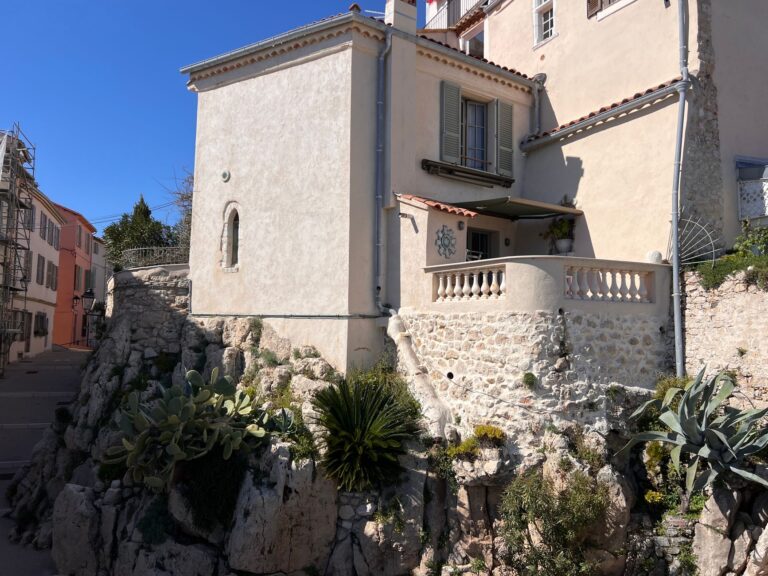
The best Mediterranean landscaping for a slope does not fight the land flat. In Provence, the most convincing gardens often work with modest changes in level: a limestone step here, a gravel landing there, terracotta pots gathered where the ground is stable, and planting that softens the edges without hiding every stone. The aim is not a grand outdoor room. It is a garden that feels as if it has been walked through for years.
Start by reading the slope, not decorating it
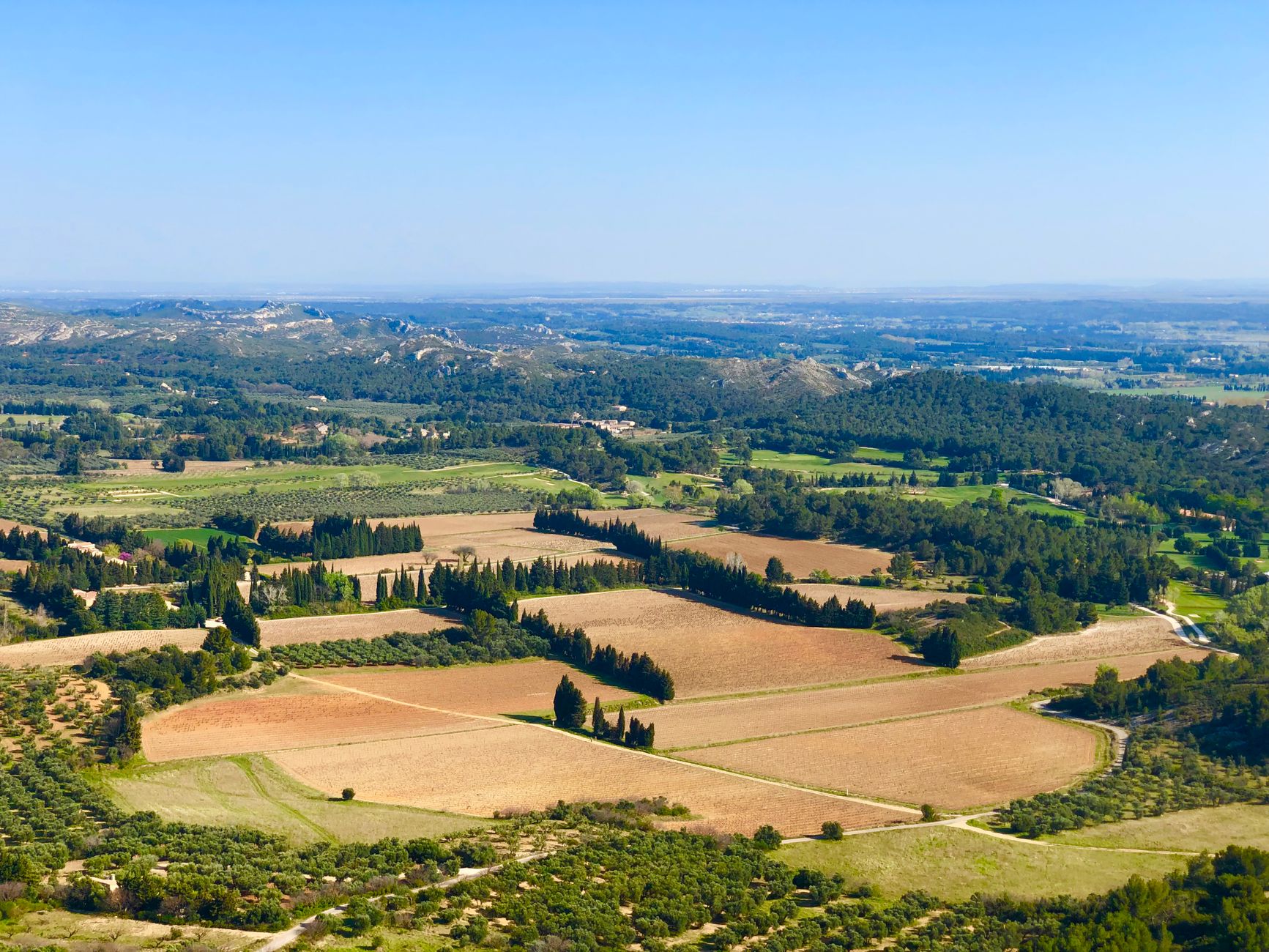
Before choosing lavender, lanterns, or pots, spend time looking at how the slope behaves. A garden that drops gently away from the house needs a different plan than one that falls sharply toward a wall. In older village houses and country mas, the most successful sloped gardens tend to have a simple hierarchy: a practical upper landing, a planted middle section, and a slower lower area where you might sit when the sun is softer.
Notice where water already travels after rain. If water cuts channels through the soil, loose gravel alone will not solve the problem. You may need edging, shallow channels, or small retaining stones to slow runoff. If one side of the garden stays damp while the other bakes in sun, treat them as different planting zones rather than forcing one repeated scheme across the whole slope.
Also pay attention to how you move. The natural route is rarely a perfect straight line. If everyone already crosses the slope diagonally, that desire line is important. A diagonal path is usually easier on the body and calmer to look at than a steep central stair marching straight downhill.
Give the garden three quiet levels of use
A sloped Mediterranean garden feels more settled when each level has a purpose. This does not mean building formal terraces everywhere. Sometimes a level is simply a widened gravel patch near the door or a pause in the path with one low bench against a wall.
The upper level: practical and close to the house
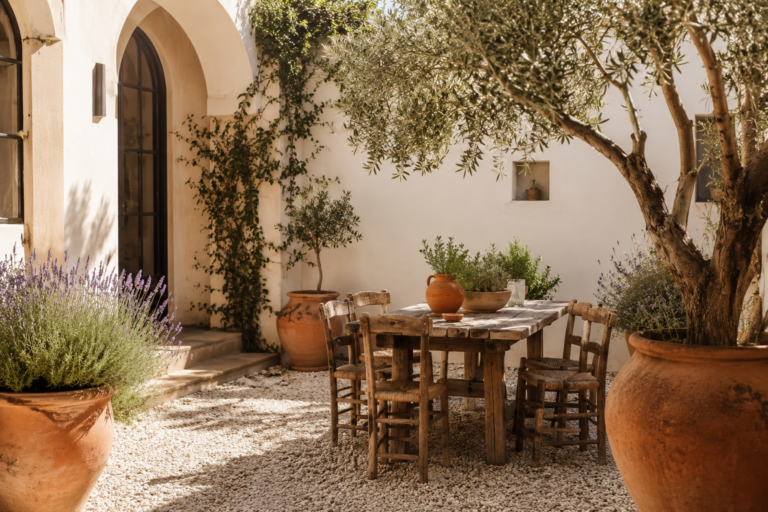
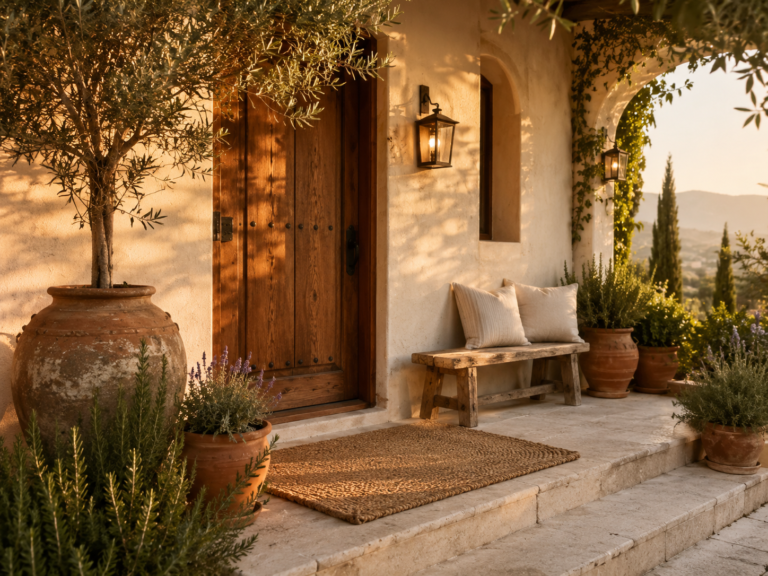
The upper level should be the easiest to maintain because it is seen every day. Use it for the things you touch often: a cluster of terracotta pots, herbs near the kitchen, a small table, or a bench where morning coffee feels natural. If the house has limewashed plaster or pale stone, keep the materials close in tone. Warm gravel, handmade terracotta, aged wood, and blackened iron are enough.
Avoid crowding this level with too many small accessories. On a slope, visual clutter reads quickly because the eye is already following changes in height. Three large pots often look calmer than nine tiny ones, especially when planted with rosemary, bay, thyme, or an olive standard.
The middle level: planting that holds the view together
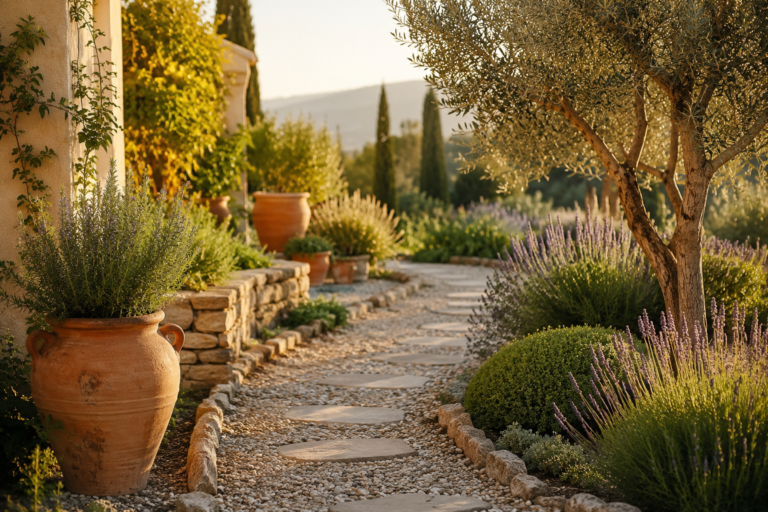
The middle section is where planting does the most work. It softens retaining edges, slows the eye, and makes the slope feel intentional. Mediterranean planting looks best when it is layered in loose bands rather than dotted about randomly. Use taller, structural plants higher or toward the back, then lower aromatic plants along the path edges.
Good choices for the mood include olive, rosemary, lavender, santolina, thyme, small cypress accents, bay, and ornamental grasses with a dry, pale movement. Choose plants suited to your climate and drainage rather than copying a Provençal palette plant for plant. The spirit matters more than the exact species.
The lower level: slower, shaded, and less furnished
The lowest part of a sloped garden should not have to carry the whole design. It can be a simple sitting nook, a gravel turn in the path, or a place for one wooden bench beneath a tree. If the space is small, leave breathing room. A slope already creates drama; the lower level can be the quiet ending.
The slope measurement rule that keeps the garden usable
Use this simple measurement rule before deciding where to put steps, pots, or seating. It is not a substitute for professional grading on a difficult site, but it helps you think clearly about comfort and proportion.
- Keep pause points at least 36 inches deep. A small landing needs enough depth for someone to stand, turn, and set down a watering can without feeling perched on the edge.
- Make garden steps broad when space allows. Shallow, generous stone steps feel more natural in a Mediterranean garden than narrow, steep steps. If the rise is significant, a local contractor or landscape professional should confirm safe dimensions.
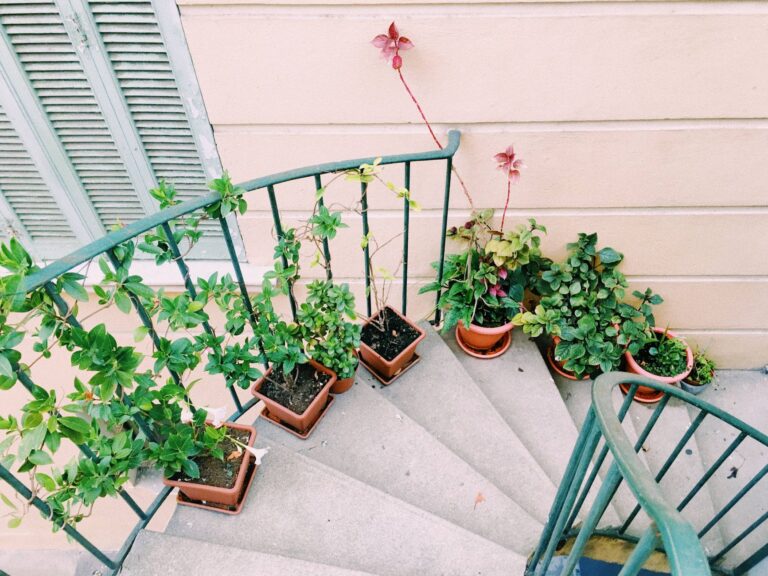
- Place pots only where the ground is level. Terracotta is beautiful, but on a slope it must sit securely. Use flat landings, step edges wide enough for stability, or gravel pads edged with stone.
This rule also helps with styling restraint. If there is no proper pause point, it is usually not the right place for a chair, lantern, or large planter. Let planted ground remain planted ground.
Choose ground materials that look settled into the land
Gravel is one of the most useful materials for Mediterranean landscaping, but it needs structure on a slope. Without edging or changes in level, it can migrate downhill and collect in unwanted places. Use gravel where it can be contained: on landings, between stepping stones, around pots, or on a gently angled path with firm borders.
Color matters. Very white gravel can glare in strong sun and feel visually hard beside old stone. Softer beige, sand, pale ochre, or grey-beige tones usually sit more quietly with limewashed walls and terracotta. If your house has pierre du Gard, limestone, or pale render, choose gravel that feels related rather than sharply contrasting.
For steps and landings, natural stone is the most convincing choice. Limestone, reclaimed stone, or matte concrete pavers in a restrained tone can all work, depending on budget and availability. The important point is finish. Glossy, highly uniform surfaces tend to look new in an uncomfortable way. A slightly irregular edge, matte surface, or warmer undertone will age more gracefully.
Stepping stones are useful when you want the garden to feel informal. Set them with enough space for a natural stride, then surround them with compacted gravel or low planting. On a steeper slope, however, stepping stones may need a firmer base and professional installation so they do not rock or become slippery.
Layer planting in bands of silver, green, and clay
The strongest Mediterranean gardens often use fewer plant types than you expect. Repetition is what makes them peaceful. On a slope, repetition also helps connect the different levels so the garden does not feel like separate fragments.
Think in bands of texture and color. A silver-green band might include lavender, santolina, or artemisia. A deeper green band might come from rosemary, bay, olive, or myrtle. Clay comes from terracotta pots, exposed earth, and the warm undertones of the path. This limited palette lets the shape of the slope remain visible.
Keep the planting lower near paths so the route feels open. Taller items, such as a slim cypress or mature shrub, are best used as punctuation rather than a screen. Too many upright plants can make a small sloped garden feel crowded and overly formal. One strong vertical near a wall or turn in the path is usually more elegant than a repeated row.
Terracotta pots are especially useful on a slope because they bring planting to the stable places. Use them near doors, on landings, and on the wider side of steps. Choose fewer, larger pots where possible, and vary height by plant form rather than by using lots of little containers. A rosemary in one pot, a small olive in another, and a low thyme spilling over the edge can be enough.
Plan seating where the ground invites you to stop
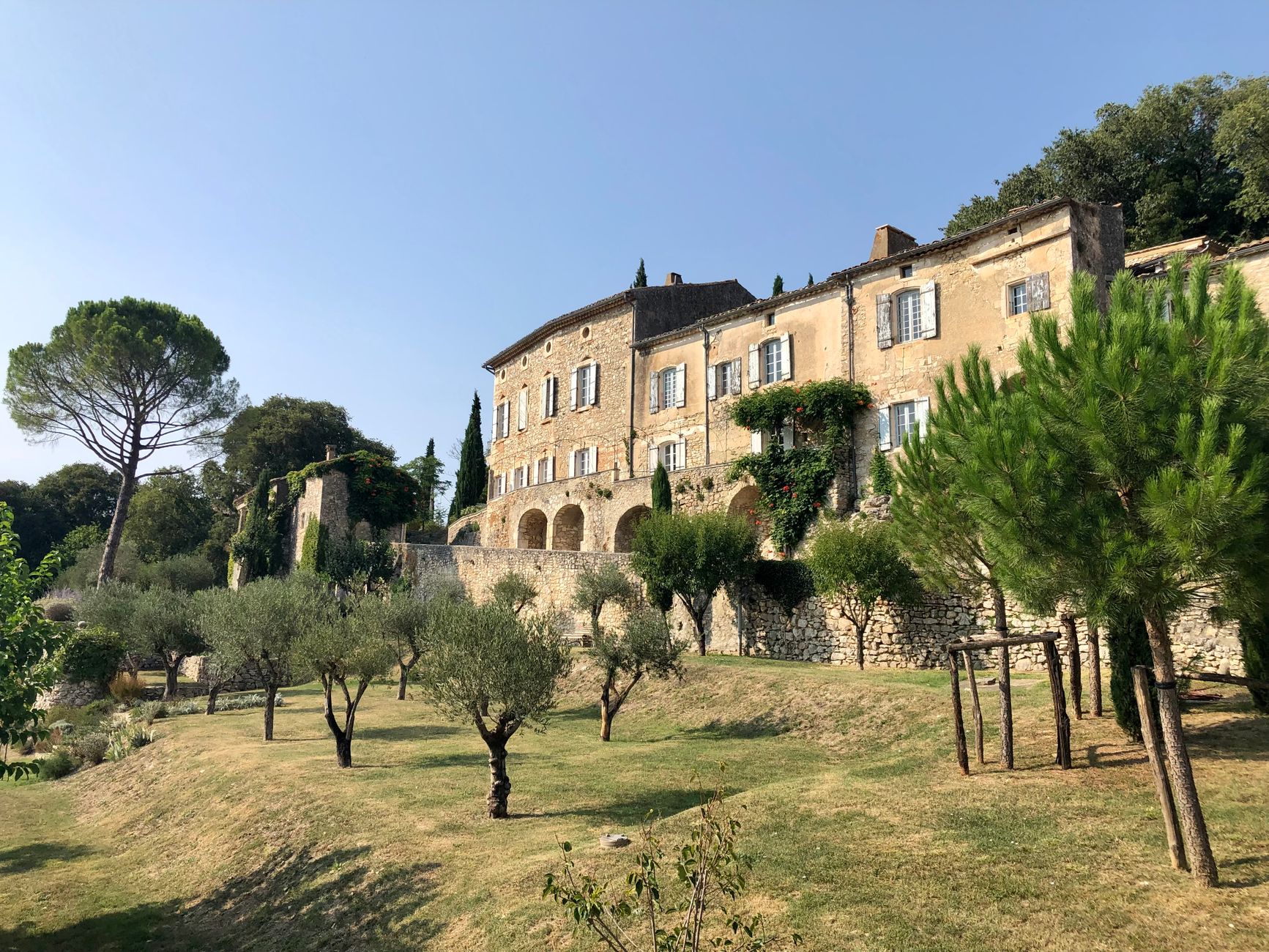
Outdoor seating on a slope should feel earned. If a bench looks as though it might slide away, the whole garden feels uneasy. The best spot is usually against a wall, beneath a tree, or along the side of a landing where the back feels protected. A simple wooden bench is often more believable than a full furniture set, especially in a modest garden.
Face the bench toward something specific: the house wall in evening light, a planted bank, a small olive tree, or a view across rooftops. If the only view is back uphill, embrace it. Looking toward terracotta pots and layered planting can be just as satisfying as looking outward.
Cushions should be restrained and practical. Natural linen tones, sand, stone, faded olive, or chalky beige keep the feeling calm. Avoid bright outdoor patterns if the garden is already full of texture from gravel, stone, and plants. On a windy slope, store cushions indoors or in a sheltered storage basket when not in use.
Use lighting to guide movement, not flatten the atmosphere
Lighting is especially important on a sloped garden because levels can become hazardous after sunset. The goal is not to flood the whole space with brightness. It is to make the route legible while preserving shadows.
Place the lowest, warmest light near steps, turns, and seating. Lanterns can work well on landings or beside a bench, provided they sit securely and do not obstruct the path. Wall sconces are useful if you have a garden wall or exterior façade near the upper level. Solar lanterns can be practical where wiring is difficult, though they should be placed where they receive enough sun and where their appearance still suits the garden.
Keep the color of the light warm rather than icy. Cool light can make limestone and gravel feel harsh, while warm light brings out the softer tones of terracotta, aged timber, and planting. More small points of light are usually better than one glaring fixture. Let the darker planted areas remain darker; that contrast is part of the charm.
Design for drainage, maintenance, and honest aging
A Mediterranean-inspired slope should not require constant fussing to look good. In fact, a little patina is part of the appeal. Terracotta deepens, timber greys, gravel shifts slightly, and plants become looser around the edges. The trick is to choose materials that age honestly rather than materials that only look good when spotless.
Drainage deserves early attention. If rainwater rushes down the slope, it can expose roots, move gravel, and stain lower walls. Small stone edges, planted bands, gravel grids, or professional drainage channels may be necessary depending on the site. It is better to correct water movement before adding decorative layers.
Maintenance should be realistic. Gravel will need raking, especially after storms. Terracotta pots dry faster in sun and wind, so they need steady watering in hot months. Aromatic plants can become woody if never clipped. A wooden bench may need seasonal cleaning or oiling depending on the finish. None of this is unreasonable, but it should be part of the design from the beginning.
For a lower-maintenance slope, reduce the number of container plants and increase in-ground planting where soil and drainage allow. Pots are beautiful, but each one is a separate watering responsibility. Use them where they count most: near the house, beside seating, and at key turns in the path.
What to avoid on a sloped Mediterranean garden
The most common problem is overbuilding. Heavy retaining walls, identical terraces, and too many hard edges can make a small garden feel engineered rather than lived in. Some structure is necessary, but it should serve movement, drainage, and comfort first.
Another issue is treating the slope like a flat patio. A large dining set placed on the only level area can make the rest of the garden feel leftover. If dining is important, create one genuinely stable eating place and keep the remaining slope softer, with planting and path movement.
Finally, avoid mixing too many decorative references. Blue glazed pots, patterned tiles, ornate lanterns, bright cushions, and sculptural furniture can quickly overwhelm a modest Provençal mood. Choose one or two expressive details and let the rest be quiet: stone, gravel, clay, greenery, and warm light.
Shop the Look
For a sloped Mediterranean garden, choose pieces that support the structure of the space: stable footing, secure planters, simple seating, and low warm light where the path changes level.
- warm garden gravel
- stone-style stepping stones
- terracotta garden pots
- solar garden lanterns
- simple wooden garden bench
A garden that follows the hill feels more enduring
The most convincing Mediterranean landscaping for a sloped garden is not the most elaborate. It is the design that makes the hill easier to live with: a steady path, a few secure places to pause, planting that looks comfortable in sun, and materials that improve as they weather.
Start with the movement of the land, then add stone, gravel, terracotta, and light only where they have a purpose. When the slope is allowed to remain visible, the garden gains character. It feels less like a project imposed on the site and more like a quiet outdoor room that has always belonged to the house.
Affiliate disclosure: La Maison du Sud may earn a commission from qualifying purchases made through links in this article, at no extra cost to you.